Analyst Wrap Up
Introduction
This article explores how the digital transformation framework can be used to develop and execute a comprehensive strategy across key business areas. Using Kroger as a case study, it examines what prompted their digital transformation, how it was implemented, and the long-term impact on the organization.
Market Drivers Prompting Kroger’s Digital Transformation
Intensifying Competitive Pressures
Kroger’s transformation began well before the pandemic, responding to mounting competitive pressures. Hard discounters and wholesale clubs were undercutting prices and offering greater convenience. By 2019, traditional supermarkets accounted for less than a third of food purchases in the U.S., and their market share had fallen from 90% to 44% (Ramaswamy, 2021).
The disruption intensified when Amazon acquired Whole Foods in 2017, integrating its digital ecosystem to offer two-hour grocery delivery. Amazon’s early investment in personalization and digital services helped it become the top U.S. retailer by 2021. Walmart followed suit, hiring thousands of engineers and data scientists to revamp its digital grocery experience (Ramaswamy, 2021). Competitors like Aldi and Publix also gained ground. The COVID-19 pandemic further accelerated digital retail by making physical stores temporarily unviable.
Evolving Customer Expectations
Customer needs evolved rapidly. Shoppers began to prioritize convenience, quality, and experience over just price. Factors like delivery speed and product availability grew in importance. In-store environments were expected to offer more than just shelves of goods—features like food courts and sampling events became increasingly common. Personalized digital engagement emerged as a major differentiator.
How Digital Transformation Contributed to Kroger’s Growth
Kroger’s digital transformation came at a high cost—$9 billion—while initially generating just $400 million in revenue. However, the onset of the pandemic gave the initiative a much-needed boost. In Q3 2020, Kroger’s sales surged by $1.9 billion, an 11.3% increase over the previous year (Ramaswamy, 2021).
Created New Revenue Streams
Kroger capitalized on its acquisition of dunnhumby by launching the 84.51° analytics division. This unit leveraged customer data for targeted marketing and began offering consulting services to other companies. The digital tools developed were further monetized through a partnership with Microsoft, forming a Retail as a Service (RaaS) offering. Solutions like Scan, Bag, and Go were licensed to other retailers, creating an entirely new stream of revenue.
Elevated E-commerce and Digital Business
The “Restock Kroger” initiative significantly enhanced the company’s digital footprint. Kroger developed a mobile app integrating loyalty programs, personalized promotions, in-store navigation, and payment features. These innovations strengthened engagement and modernized the customer experience.
The Digital Transformation Framework
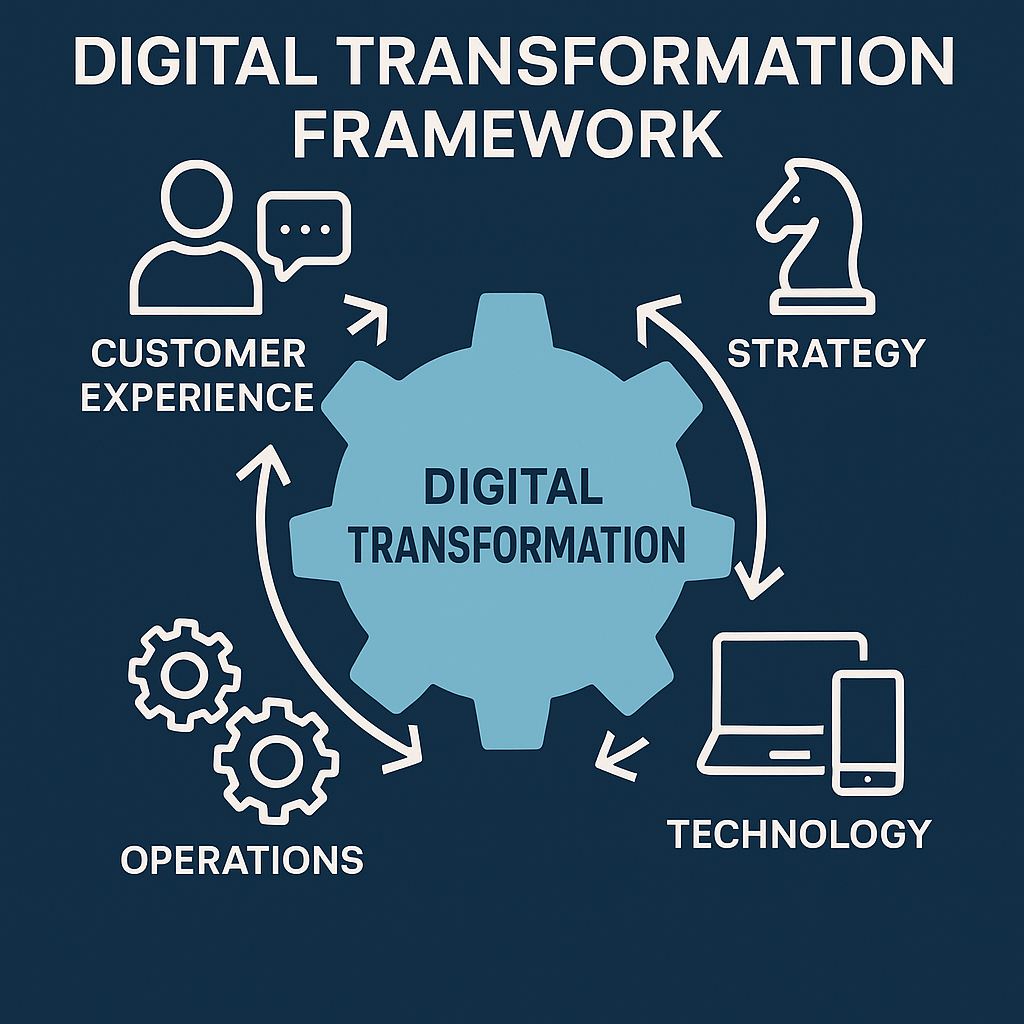
The digital transformation framework is a structured approach for executing end-to-end strategies across the enterprise, avoiding fragmented tech initiatives. It aims to give companies a competitive edge through digital tools and organizational change, using data-driven decision-making. The five core areas include:
- Business Model
- Customer Experience
- Operations
- Employee Experience
- Digital Platform
Transformation Areas at Kroger
Customer Experience
Kroger emphasized seamless experiences across digital and physical stores. AI and predictive analytics were applied to loyalty program data for personalized promotions, product recommendations, and real-time digital coupons. Smart shelf technology and touchless checkout via the Scan, Bag, and Go app streamlined in-store journeys. Autonomous delivery through a partnership with Nuro addressed last-mile logistics, tapping into a projected $41 billion market (CB Insights, 2022).
Operations
To support e-commerce at scale, Kroger partnered with Ocado to automate warehouse operations. The collaboration accelerated a transformation originally estimated to take 5–10 years (Ramaswamy, 2021).
Business Model
Kroger transformed its core grocery business by monetizing its data assets and digital tools. 84.51° offered AI-driven marketing services to both internal teams and external suppliers. In partnership with Microsoft, the company commercialized its RaaS suite, including the smart shelf and touchless checkout systems. Collaborations with Alibaba expanded market reach through Kroger-branded products.
Conclusion
Kroger’s experience illustrates how a digital transformation framework can be applied across business functions to improve performance and create new opportunities. However, these strategies are not universally effective and require tailored application. Kroger initially struggled with profitability until external conditions shifted the trajectory. The framework itself is not a detailed roadmap but a lens for identifying end-to-end opportunities rather than pursuing siloed efforts. Technology must align with business needs and timing to deliver meaningful results. The integration of digital systems across operations, marketing, customer experience, and service delivery helped position Kroger for sustainable growth.
Additional questions remain about how much of this success was enabled by the pandemic, and whether the same results would have occurred under different circumstances. Some technologies may have been too advanced for their time. Deeper research into the root causes of slow initial adoption and the eventual success factors could help refine future digital strategies.
References
Ramaswamy, K., Youngdahl, W., & Molera, K. (2021). The digital transformation of Kroger: Remaking the grocery business. Thunderbird School of Global Management, Arizona State University Enterprise (Case No. A08-21-0010).
Bonnet, D., & Westerman, G. (2021). The new elements of digital transformation. MIT Sloan Management Review. https://sloanreview.mit.edu/x/622103
Salesforce US. (2025). What is digital transformation? A complete guide. https://www.salesforce.com/digital-transformation/?d=nav-prev
CB Insights. (2022, January 5). What does Walmart’s driverless delivery strategy & future look like? https://www.cbinsights.com/research/walmart-driverless-autonomous-delivery-strategy/
Fortune Business Insights. (2025, April 21). Data analytics market size, share & industry analysis, regional forecast, 2025–2032. https://www.fortunebusinessinsights.com/data-analytics-market-108882

 Supply Chain Advisors
Leave a comment