
Independent NVIDIA SWOT Analysis, Customer Value and Competitive Positioning
Introduction
The NVIDIA RTX series is a market leading product in the discrete GPU industry. NVIDIA has brought cutting-edge technologies like DLSS, Reflex, Ray Tracing to market through this platform, which has significantly enhanced GPU performance. However, despite these advancements the RTX series faces challenges when it comes to pricing, input latency and an increasingly competitive market. This report provides a thorough SWOT analysis, assesses considerations to increase customer value and provides a roadmap to strengthen NVIDIAs competitive position in the market.
Strengths
Innovation
The NVIDIA RTX series is known for its innovative features, such as ray tracing and Deep Learning Super Sampling. These features enable life like graphics and high-end gaming performance. These features give the card a competitive edge, by inferentially enhancing image generation opposed to brute force algorithmic computation. This enables the RTX series to upscale to higher resolutions without additional compute power, thus giving RTX a sizable boost in terms of overall performance relative to its competitors. According to an author from IGN, “Nvidia DLSS has been an industry-changing technology and has only gotten better with time. It’s a system that shows no signs of slowing and quite to the contrary, Nvidia has signaled a continuing dedication to improving it over time. It’s not perfect, but at its best, it can be very impressive and impactful to your gaming experience while also allowing you to extend the life of your GPU.” (Coke, 2025)
Performance
The RTX series is known for its market leading performance. Competitive benchmarking tests suggest that the RTX model is the top performing card in low, medium and high segments (See figure 1).
Figure 1
Average Frame Rates across relative and competitive products

Note: The data comes from competitive benchmarking analysis provided by an author from tomshardware.com (Jarred Walton, 2025)
Strong Brand Reputation and Ecosystem
The RTX series has established a strong reputation by bringing features that consumers want to market. According to tech radar, “The combination of RTX GPU acceleration and AI-powered features enables creators to focus on creativity rather than being bogged down by annoying technical limitations.” (TechRadar Team, 2024)
Excellent Power Management
The RTX series has excellent power management relative to its peers. The NVIDIA product in the Mid-Range pricing tier is 20% more efficient than the AMD equivalent (See figure 2).
Figure 2
Average Power Consumption of the RTX 4070 Ti vs RX 7900 XT
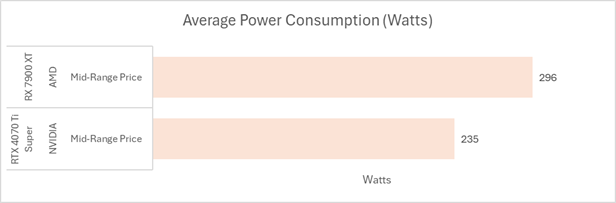
Note: The data comes from competitive benchmarking analysis provided by an author from tomshardware.com (Jarred Walton, 2025)
Weaknesses
Premium Pricing
The current market price of the RTX product in the Mid-Range pricing tier is about $600 higher than its AMD equivalent (Amazon, 2025). Premium positioning could deter price sensitive consumers for the mid-range RTX products.
Input Latency Issues With DLSS
DLSS solves the issue of frame rate generation, however it doesn’t resolve the issue of input latency which could be problematic for competitive gamers that require low input latency. According to Jarred Walton, “if you’re only getting a generated FPS of 40 as an example, it can feel very sluggish and laggy, even if it looks reasonably smooth. That’s because the user input gets sampled at 20 FPS” (Walton, 2025).
Product Tiers Overcomplexity
The RTX series offers an extensive list of products addressing a wide breadth and depth of the overall market. Each product offers varying levels of performance, price and features. For the uninformed buyer, the amount of information to navigate can be overwhelming. Jarred Walton offers a guide for consumers to consider while shopping for their next GPU, “for the uninitiated, the process of figuring out which GPU to buy can be intimidating” (Walton, 2024).
Opportunities
Increase Number of Chip Suppliers
One of NVIDIA’s primary challenges is securing chips from chip manufacturers. NVIDIA forecast it slowest revenue growth in seven quarters and indicated that supply chain constraints would lead to demand for its chips exceeding supply for several quarters even into 2026 (Nellis and Soni, 2024). NVIDIA could increase the number of chip suppliers to expedite sales.
Data Centers & Cloud Gaming
Cloud gaming is a rapidly emerging market. NVIDIA is developing the GeForce platform which positions itself as a product that can turn any device into a GeForce RTX gaming PC. The cloud gaming market is estimated to generate $11.1 billion in revenue in 2025, which is a 58% increase over last year. By 2030, the market is estimated to grow to $64 billion and $140 billion by 2032 (Chauhan, 2025).
Improve Input Latency
As mentioned before, DLSS improves frame generation however doesn’t provide much in terms of input latency which is a fundamental requirement in high performance competitive gaming. NVIDIA should continue to invest and develop Reflex, which is a promising feature just recently introduced. Reflex is already proving to reduce latency by an average of 50% in top competitive games (Burnes and Usmani, 2025).
Threats
Single and Sole Sourced Supply Chain
Taiwanese Semiconductor Manufacturing Company (TSMC) is the only manufacturer capable of producing the Ada Lovelace architecture four-nanometer chip for the RTX 40xx series. Single source is a significant risk to the supply chain. If TSMC were to experience a disruption, NVIDIA may not be able to get the supplies they need.
Trade Compliance Issues
Political pressures could create a challenge in sourcing chips from Taiwan. The current administration has proposed a 100% tariff on Taiwanese chip imports. This is a substantial threat to the profitability of the RTX product line (Drury, 2025).
Competitors catching up on AI frame generation technology
NVIDIA DLSS is no longer alone in the frame generation space. AMD and intel are now offering their own upscaling and AI-Enabled features to compete with DLSS (Coke, 2025). Although NVIDIA was first to market and has had a significant amount of time to refine their product, AMD and Intel will likely be able to develop a product on par with NVIDIA at a fraction of the investment.
Transition from physical based to cloud computing solutions
Physical systems require bulky hardware that takes up space and require an overwhelming amount of research to make an informed purchase. As cloud computing technology advances and closes the performance gap between physical and cloud-based computing, consumers will naturally seek to reduce complexity and move to cloud-based platforms. This would impact direct to consumer sales of the RTX cards.
Customer Value Recommendations
Address input Latency
NVIDIA could increase investments in refining its Reflex technology, which addresses the issue with input latency. Although DLSS solves the issue of frame generation, input latency remains a major issue for competitive gamers. According to NVIDIA, Reflex technology has already proven that it can achieve a 50% latency reduction in leading competitive games (Burnes & Usmani, 2025). Further investments in this technology would not only improve gameplay responsiveness but would also position RTX GPUs as the leading product for gamers, thus directly aligning with customer demands for responsiveness.
Simplify Product Tiers
The current RTX series spans across multiple tiers, with varying levels of performance, pricing and features. Picking a GPU can be intimidating as consumers need to navigate price, monitor resolution, refresh rate, power requirements, space requirements, overclocking, which board partner to use, etc. There are literally hundreds of graphics cards from dozens of manufacturers (Jarred Walton). Studies have confirmed that more options are not always better. As the number of options increase sales volume and customer satisfaction have shown to decrease (Barry Schwartz, 2006). Reducing the complexity of NVIDIAs extensive product lineup could simplify customer decision-making and increase customer perceived value.
Improve Product Availability
NVIDIA consistently carries a substantial backorder. Currently, NVIDIA is predicting demand to exceed supply for several quarters into 2026 (Nellis & Soni, 2024). Although this could be a positive indicator that NVIDIAs products are popular and in high demand, availability issues can be frustrating for consumers. The shortage in supply has driven the market price significantly higher than MSRP. Addressing the ongoing availability issue is essential for decreasing prices and increasing customer value.
Cloud Integration
NVIDIA should accelerate the development of cloud gaming architecture and expand partnerships with cloud computing agencies. Improving NVIDIAs cloud services and moving to a cloud-based model will significantly improve customer value by increasing flexibility, accessibility and eliminating the need for purchasing physical equipment. The cloud gaming market is expected to grow from $11 billion to $140 billion from now until 2032, which is indicative of demand for cloud-based options (Chauhan, 2025). The discrete physical GPU market negatively correlates to the cloud compute market. NVIDIA should begin to make strategic investments now to ensure relevance in the future market and maintain a competitive edge.
Competitive Position Recommendations
Diversify Supply Chain
NVIDIAS’ heavy reliance on TSMC as a single source supplier for the RTX 40xx series represents a major risk. If disruptions occur at TSMC due to geopolitical tensions or production issues, NVIDIA may be unable to source the chips needed to produce their products. Developing partnerships with additional semiconductor manufacturers would not only reduce some of these supply chain risks but could also increase bargaining and negotiating power for better pricing. Negotiation power is low when the number of suppliers competing in the industry is few and the cost of switching suppliers is high (Cook, 2024). Finally, by increasing the number of chip suppliers, NVIDIA could solve the availability issue and deliver more products to the market. Creating more supply to fulfil demand will reduce the market price closer to MSRP. Diversifying and increasing the number of chip suppliers is key to improving NVIDIA’s competitive position in the market.
Accelerate Transitions to Cloud based solutions
It’s imperative that NVIDIA proactively addresses the industry shift from physical to cloud-based compute solutions. Cloud computing offers a substantial competitive opportunity for NVIDIA. As the performance gap between physical and cloud-based compute is reduced, consumers increasingly prefer cloud solutions due to convenience and reduced complexity. According to Alix partners, “consumers are likely to spend more money on streaming games from the cloud rather than investing in gaming consoles and personal computers” (Chauhan, 2025). Cloud computing would be a significant shift from selling compute as a physical product to compute as a service. Compute as a service is massively and rapidly scalable to anyone with a Wi-Fi connection, which potentially opens an entirely new untapped market. NVIDIA should accelerate its investment and innovation in cloud technology, specifically their GeForce now cloud gaming platform, to begin to migrate its consumers to cloud based gaming. Expanding NVIDIA cloud gaming presence will protect and expand their competitive position in the GPU market and unlock new customers.
Continue Innovation in AI technologies & Partnership with Game Developers
NVIDIA has an opportunity to significantly reduce the cost of their products by accelerating innovations in AI technology. Continued advancements in DLSS and Reflex technology will help to improve frame generation and reduce input latency which can significantly improve the performance of cheaper cards. AI essentially allows NVIDIA to provide more value with less, ultimately reducing the cost of goods sold. Reducing COGs will enable NVIDIA to price their products even more competitively. NVIDIA must also enhance support for DLSS. Currently there are only a limited number of games that support DLSS (Walton, 2024). By enhancing DLSS, Reflex and increasing game developer adoption, NVIDIA can improve their competitive position in the market.

 Supply Chain Advisors
Leave a comment